
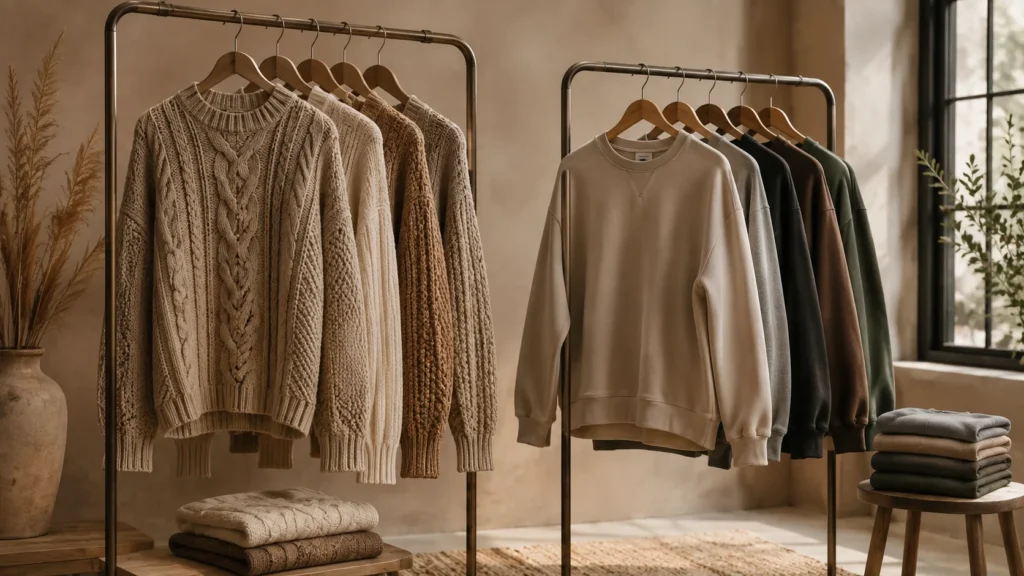
Sweater. Sweatshirt. Pullover. Jumper. Hoodie. If you’ve ever stood in front of your closet — or a store rack — trying to figure out which word actually applies to which garment, you’re not alone. These terms get used interchangeably in everyday conversation, but they describe genuinely different pieces of clothing, made from different materials, built for different purposes, and appropriate in different settings. This guide breaks down exactly what separates a sweater from a sweatshirt, so you can shop, dress, and talk about your wardrobe with more precision.
Quick Answer: What’s the Difference Between a Sweater and a Sweatshirt?
A sweater is a knitted garment, traditionally made from wool, cashmere, cotton, or acrylic yarn, designed primarily for warmth and often worn in more polished or formal settings. A sweatshirt is a garment made from a fleece-backed knit fabric, most commonly cotton or a cotton-poly blend, originally designed for athletic wear and casual comfort rather than formality. The core distinction comes down to construction and fabric: sweaters are knitted stitch by stitch, while sweatshirts are cut and sewn from a fleece fabric — and that difference shapes everything else, from warmth to texture to where each one fits in your wardrobe.
What Is a Sweater?
A sweater is a knitted upper-body garment, meaning it’s constructed by interlocking loops of yarn rather than woven or cut from fabric. This knitted structure is what gives sweaters their stretch, their close, textured surface, and their reputation as a warmer, more insulating layer than a typical woven shirt. Sweaters have existed in some form for centuries, originally developed as practical, warm workwear before evolving into the wide range of styles seen today — crewneck, V-neck, turtleneck, cardigan, and more.
Common Sweater Materials
Sweaters are most commonly made from wool, cashmere, cotton, or acrylic yarn, and increasingly from blends of these fibers. Wool and cashmere are prized for natural insulation and a refined drape, which is part of why sweaters read as more “elevated” than sweatshirts in most dress codes. Cotton and acrylic sweaters trade some of that warmth and softness for easier care and a lower price point, making them a common choice for everyday wear.
What Is a Sweatshirt?
A sweatshirt is a pullover or zip-up garment made from a fleece-backed knit fabric — typically soft and brushed on the inside, smoother on the outside. Unlike a sweater, it isn’t knitted stitch by stitch; it’s cut and sewn from fabric, similar to a T-shirt but with a thicker, insulated material. Sweatshirts originated as athletic and workout wear in the early 20th century, designed to absorb sweat and provide warmth during physical activity — which is reflected directly in the name.
Common Sweatshirt Materials
Sweatshirts are most commonly made from cotton fleece or a cotton-polyester blend, sometimes with added elastane for stretch. Cotton fleece is valued for its softness and breathability, while cotton-poly blends are common because they resist shrinking and pilling better than 100% cotton. This is also why sweatshirts, compared to sweaters, tend to hold their shape better through repeated washing but generally don’t match the natural warmth-to-weight ratio of a good wool sweater.
Sweater vs Sweatshirt: The Core Differences
| Feature | Sweater | Sweatshirt |
| Construction | Knitted, stitch by stitch | Cut and sewn from fleece fabric |
| Common materials | Wool, cashmere, cotton, acrylic | Cotton fleece, cotton-poly blends |
| Origin | Traditional knitwear, centuries old | Athletic wear, early 1900s |
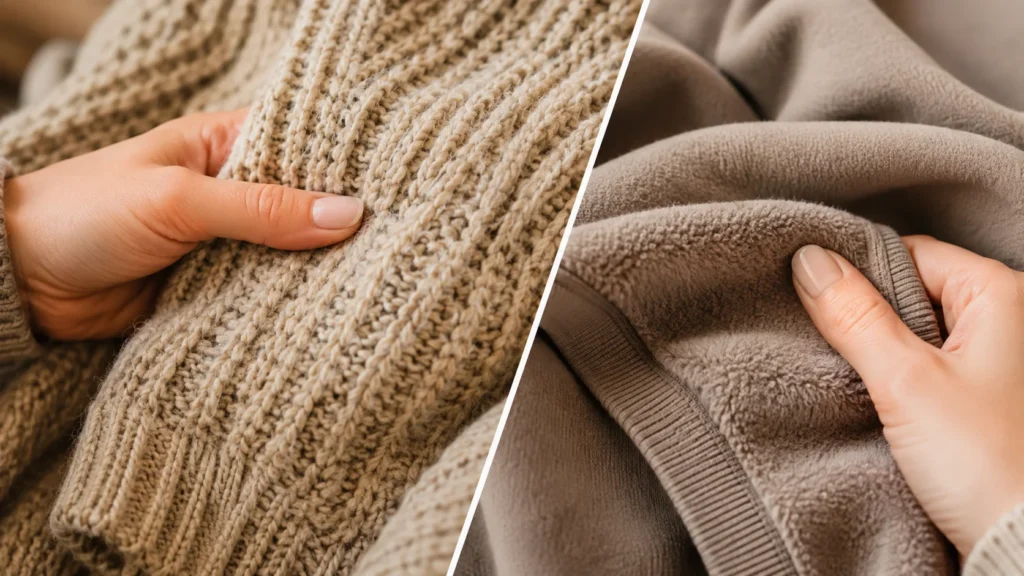
| Texture | Ribbed, textured, often has visible knit pattern | Smooth outside, brushed/fleecy inside |
| Formality | Ranges from casual to business casual/dressy | Almost always casual |
| Typical use | Layering, cold-weather dressing, office-appropriate looks | Workouts, lounging, casual everyday wear |
| Care | Often requires gentler washing (hand wash or delicate cycle for wool/cashmere) | Usually machine washable, more durable to frequent washing |
This side-by-side comparison is the fastest way to settle the sweater vs sweatshirt question in practice: if you’re looking at a knitted, textured garment meant to be worn with a collared shirt or blazer, it’s a sweater; if you’re looking at a soft, fleece-lined pullover meant for the gym or a lazy weekend, it’s a sweatshirt.
Fabric and Construction: Why They Feel So Different
The construction method is really the root of every other difference between these two garments. Because a sweater is knitted, the yarn loops trap air between them, which is part of why wool and cashmere sweaters feel warm relative to their weight — that trapped air acts as insulation. A sweatshirt’s fleece fabric works differently: it’s a woven or knit base fabric with a brushed fleece backing added afterward, which creates warmth and softness through the fleece’s raised fibers rather than through the same air-trapping structure a knit relies on.
In practice, this means a mid-weight wool sweater will often keep you warmer in genuinely cold weather than a cotton sweatshirt of similar thickness, while a sweatshirt tends to feel more casual and “sporty” against the skin due to its smoother outer surface and heavier, more uniform fabric weight.
When to Wear a Sweater vs a Sweatshirt
Work and Formal Settings
Sweaters are generally considered appropriate for business casual and even some business formal settings, especially fine-gauge wool or cashmere styles worn over a collared shirt. Sweatshirts, by contrast, are rarely considered appropriate for a professional dress code — even a clean, well-fitted sweatshirt typically reads as too casual for an office environment, client meeting, or formal event.
Casual and Athletic Settings
Sweatshirts excel in exactly the settings they were designed for: workouts, lounging, travel days, and casual weekend wear where comfort and durability matter more than polish. Sweaters can absolutely work in casual settings too — a chunky knit sweater with jeans is a classic casual look — but sweatshirts generally aren’t substituted the other way around into more dressed-up occasions.
Common Overlaps and Hybrid Garments
Some garments deliberately blur this line, which is part of why the confusion exists in the first place. “Sweater fleece” or “sweater-knit” sweatshirts are designed to mimic a knitted sweater’s texture while using sweatshirt-style fleece construction underneath — a hybrid meant to offer sweatshirt comfort with a slightly more polished look. Similarly, lightweight knit pullovers made from cotton can sometimes look similar to a heavier sweatshirt at a glance, which is why checking the actual fabric and construction, not just the silhouette, is the more reliable way to tell them apart.
Regional Terms: Jumper, Pullover, and Hoodie Explained
Language adds another layer of confusion here, especially across English-speaking regions. In British English, “jumper” is simply the standard word for what American English calls a sweater — it’s the same garment, not a different one. “Pullover” is a broader term used in both dialects that can describe either a sweater or a sweatshirt, as long as it doesn’t open at the front (as opposed to a cardigan or a zip-up). A “hoodie” is specifically a type of sweatshirt with an attached hood, not a separate garment category from sweatshirts — it’s a sweatshirt variant, the same way a turtleneck is a sweater variant.
Common Mistakes People Make With These Terms
Assuming “pullover” and “sweater” always mean the same thing. Pullover describes the front-closure style (no zipper or buttons), which can apply to sweatshirts too — it’s not exclusive to sweaters.
Judging the garment by thickness alone. A thick cotton sweatshirt and a thin cashmere sweater can be similarly warm despite looking very different in bulk; construction and fiber matter more than thickness for actual insulation.
Wearing a sweatshirt to a setting that calls for a sweater. Even a nice, minimal sweatshirt generally doesn’t read as business casual the way a knit sweater does — this is one of the most common and easily avoidable style missteps.
Overlooking care label differences. Treating a wool sweater like a cotton sweatshirt in the wash — hot water, high heat drying — is a common way sweaters end up shrunk or felted, since knitwear generally needs gentler care than fleece.
Expert Tips for Choosing the Right One
- If you need one versatile piece for both casual weekends and slightly dressed-up occasions, a mid-weight knit sweater in a neutral color will generally serve you better than a sweatshirt.
- For workouts or genuinely cold outdoor activity where moisture matters, a cotton-poly blend sweatshirt or a technical fleece will usually outperform a wool sweater, which can hold moisture and feel heavy if it gets damp.
- Check the fabric composition tag, not just the silhouette, when shopping online — “sweater-knit” or “sweater fleece” listings are often sweatshirts styled to look like sweaters, which matters if you specifically want true knitwear.
- For gifting, a classic knit sweater in a natural fiber like wool or cotton tends to read as more thoughtful and versatile than a sweatshirt, which is often perceived as more casual and less occasion-specific.

Frequently Asked Questions
Is a sweatshirt considered a type of sweater?
No. While both are worn as warm upper-body layers, they’re built differently — a sweater is knitted from yarn, while a sweatshirt is made from cut-and-sewn fleece fabric. They’re related in function but distinct in construction.
Which is warmer, a sweater or a sweatshirt?
It depends on the specific garment, but a wool or cashmere sweater is generally warmer relative to its weight than a cotton sweatshirt, due to the natural insulating properties of the knit structure and fiber.
Can I wear a sweatshirt to work?
Generally not for most professional or business casual settings — sweatshirts read as too casual for most workplaces, whereas a fine-knit sweater is typically considered appropriate.
What’s the difference between a hoodie and a sweatshirt?
A hoodie is a specific type of sweatshirt that includes an attached hood; it’s a variation within the sweatshirt category, not a separate garment.
Is a jumper the same as a sweater?
Yes. “Jumper” is the British English term for what American English calls a sweater — it refers to the same garment.
Why do sweaters cost more than sweatshirts sometimes?
Sweaters, especially those made from wool or cashmere, involve more labor-intensive knitting processes and higher-cost natural fibers, which generally makes them more expensive than mass-produced cotton-blend sweatshirts.
Can a sweatshirt be dressed up?
To a limited degree — pairing a clean, well-fitted sweatshirt with tailored pants and clean sneakers can work for smart-casual settings, but it generally can’t replace a sweater in business casual or formal contexts.
What does “pullover” mean if it’s not the same as sweater?
Pullover describes any garment without a front closure (no zipper or buttons) that’s worn by pulling it over the head — this can apply to both sweaters and sweatshirts.
Do sweaters and sweatshirts require different washing methods?
Often, yes. Wool and cashmere sweaters typically need gentler care — hand washing or a delicate cycle with cold water — while cotton-blend sweatshirts are generally more machine-wash-friendly and durable to repeated washing.
How do I tell them apart just by looking at a garment?
Check the fabric texture: a visible knit pattern with ribbing at the cuffs and hem usually indicates a sweater, while a smooth outer surface with a soft, brushed inner lining usually indicates a sweatshirt.
Final Takeaway
The difference between a sweater and a sweatshirt comes down to construction and fabric first, and everything else — warmth, texture, formality, care — follows from that. A sweater is knitted, typically from wool, cashmere, cotton, or acrylic, and generally works in more polished settings; a sweatshirt is cut from fleece fabric, typically cotton-based, and belongs firmly in casual and athletic wardrobes. Next time you’re unsure which one you’re looking at, check the construction and fabric rather than relying on thickness or general appearance alone.

At Decor Artly, we bring art, home decor, and personal style together to create beautiful spaces and inspiring lifestyles. Led by Design Director Roni, we offer curated artwork, elegant home accents, and personalized styling to help you express your unique taste.