

A red and white Christmas tree is the most classic color scheme of the season, and also the easiest to get right, because the palette does most of the styling work for you. The contrast between deep red ornaments, crisp white accents and dark green branches reads instantly as Christmas, photographs beautifully and suits everything from a farmhouse living room to a modern apartment. This guide covers the color ratio that keeps the tree balanced, the ornaments and ribbon that build the look, the right topper and skirt, the lighting choice that changes the whole mood and the variations that take the scheme from candy sweet to quietly elegant.

Why Does a Red and White Christmas Tree Always Work?
Red and white works because it is the season’s original palette — Santa’s suit, candy canes, cranberries in snow — so the eye already reads it as festive before a single ornament registers. The scheme is also forgiving: the two colors flatter each other from across the room, white brightens the dark green of the branches, and red supplies the warmth that an all white tree can lack. It scales to any budget, because red baubles are the cheapest and most widely sold ornaments every year, and white can come from ribbon, snow spray, paper or fabric already in the house. The look also carries through the rest of the room easily, pairing with a matching Christmas mantle treatment and red cushions or throws. Unlike trend colors that date quickly, a red and white tree made this year still looks correct in photographs a decade from now.
What Is the Right Red to White Ratio on a Tree?
Balance is what separates a designed tree from a random one, and the simplest formula is roughly sixty percent red, thirty percent white and ten percent of a third texture like natural wood, clear glass or warm metal. Start with red as the base layer of baubles spread evenly through the branches, then add white as the highlights — larger white ornaments, white ribbon or white floral picks placed where the eye should land. The final ten percent adds depth: pinecones, wooden beads or a little gold or silver sparkle keeps the two color scheme from looking flat. If the tree starts to read too red, the fix is almost always more white near the top and outer edges rather than removing red from deep in the branches. Step back every few minutes while decorating, because ratio mistakes are only visible from across the room, never from inside the branches where you are standing. The layering order behind this follows the same logic as any well built tree in this guide on how to decorate a Christmas tree.
Which Ornaments Suit a Red and White Tree Best?
Mix finishes rather than shapes. Matte red baubles give the scheme its depth, glossy red ones catch the light, and glitter or sequined pieces should be the minority so the tree sparkles instead of shouting. White ornaments work best in textured forms — flocked balls, white ceramic shapes, knitted or felt pieces and frosted glass — because plain glossy white can disappear against the lights. Candy cane stripes are the bridge ornament of this palette, carrying both colors in one piece, and a handful of them ties the whole tree together. Add shape variety with a few larger statement pieces: white snowflakes, red berry sprays pushed deep into the branches, and small white birds or stars near the top. Keep ornament sizes in three tiers, large deep inside near the trunk, medium through the middle and small at the tips, so the tree looks full rather than decorated only on its surface. Craft and hobby stores stock every finish in both colors in one aisle, and red and white ornament sets fill the seasonal shelves at Michaels when you want the palette matched in a single box.
How Do You Style Ribbon on a Red and White Tree?
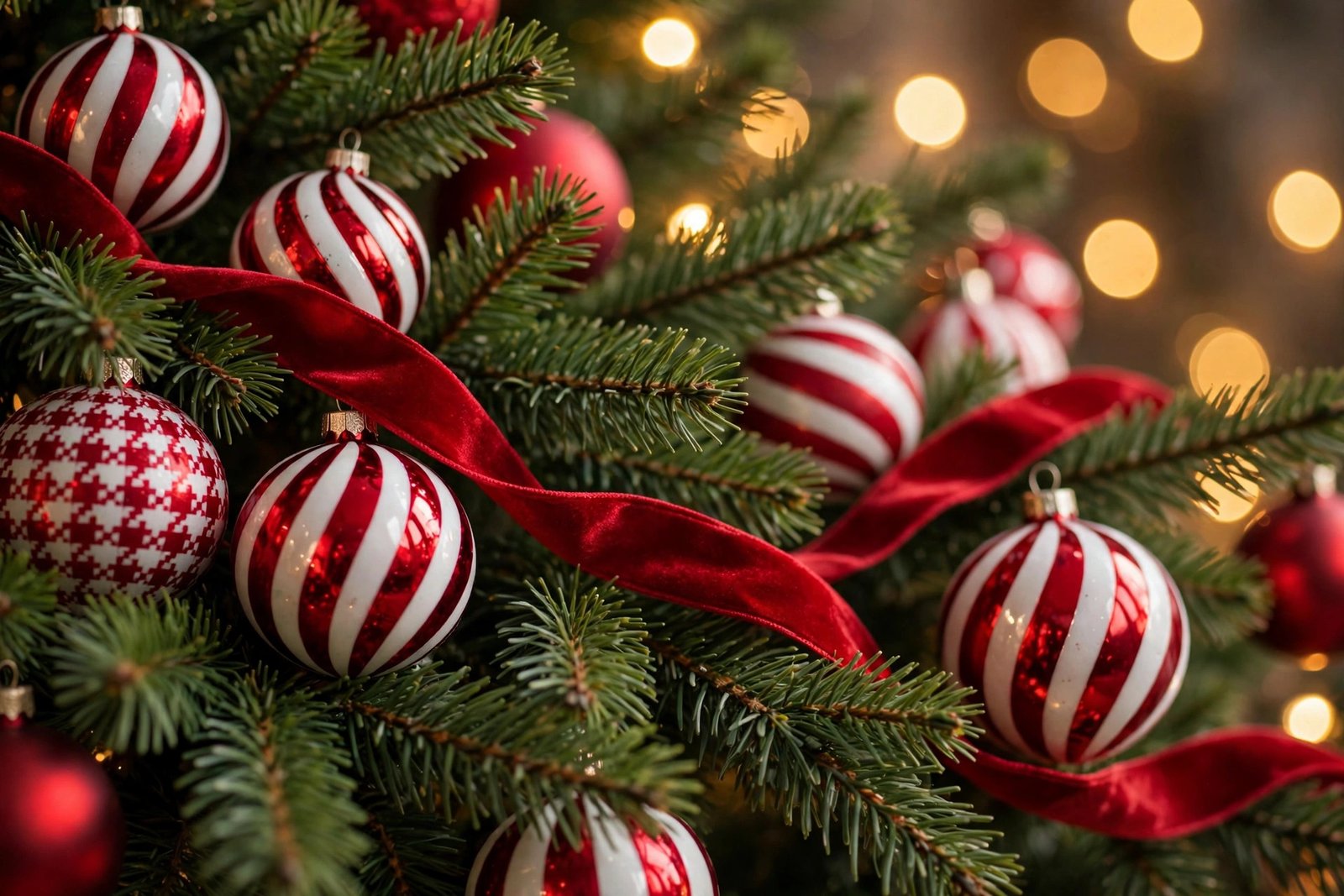
Ribbon is the cheapest way to make this palette look expensive. A wide red velvet ribbon gives the tree a classic, tailored feel, while a red and white gingham or candy stripe ribbon pushes it playful and country. There are three reliable ways to apply it: cascading lengths tucked from top to bottom, a spiral wrapped loosely around the tree, or short cut pieces stuffed between branches as soft loops and bows. Wired ribbon holds its shape and is worth the small extra cost, and two narrower ribbons layered together — one red, one white — look richer than a single wide band. Cut ribbon into the tree rather than wrapping the whole roll in one unbroken spiral when the tree is large, because separate tucked pieces read as volume instead of a stripe painted around it. Tuck the ribbon ends deep so only the loops show. Ribbon also solves the thin tree problem on its own, adding apparent fullness before a single ornament is hung.
Which Topper and Skirt Complete the Look?
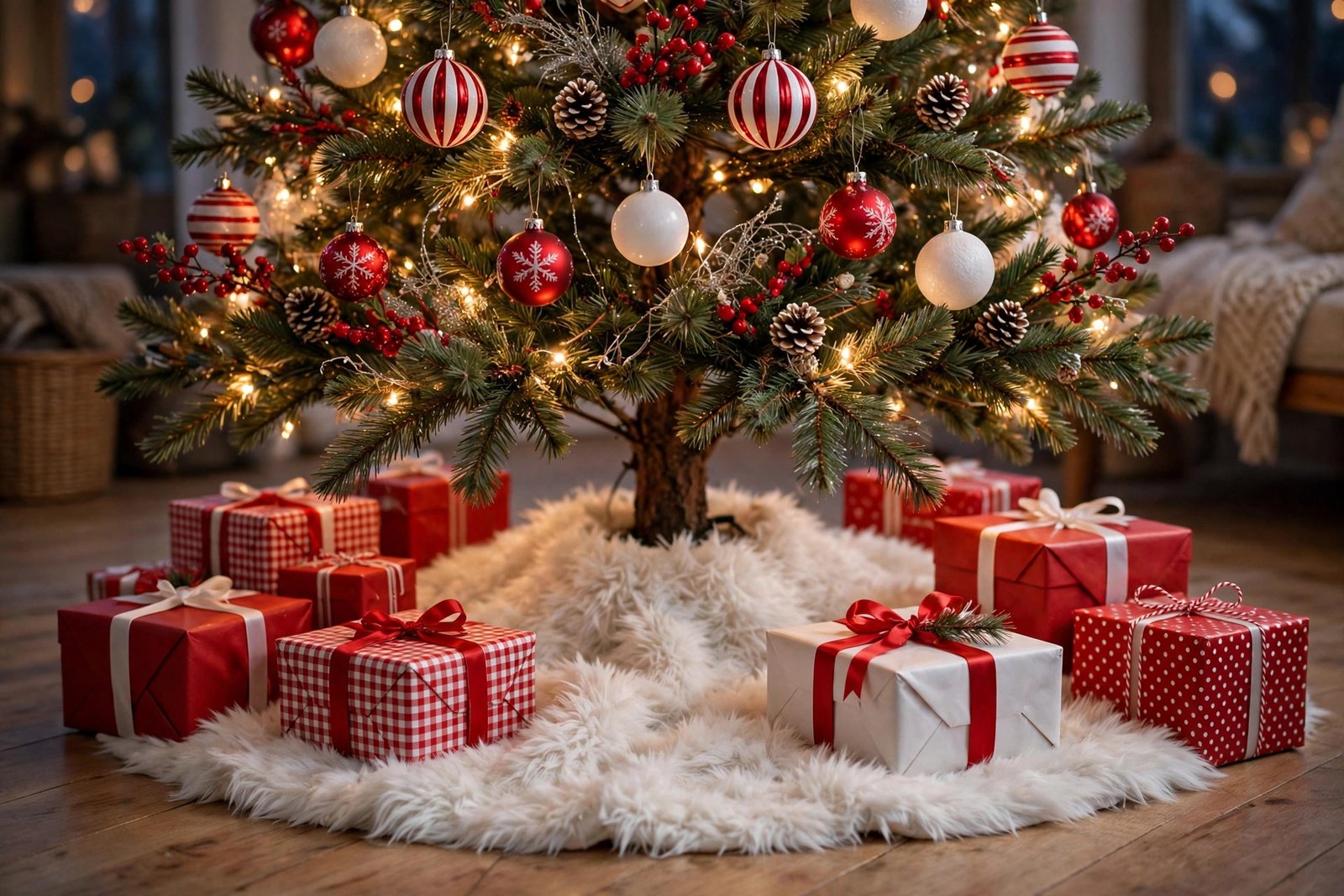
The topper should crown the palette, not fight it. A white star or a flocked snowflake keeps the top of the tree bright, a red bow made from the same ribbon used in the branches ties the scheme together, and a classic Santa or angel figure suits traditional rooms. Avoid a topper in a third strong color, because the eye will go there first and the red and white story breaks. At the base, a white faux fur or flocked tree skirt gives the snowy ground the palette promises, while a red skirt with white trim suits a bolder, more playful room. A woven basket collar in natural tones works as the neutral ten percent and hides the stand completely. Whatever sits at the base, let a few wrapped gifts echo the palette — red paper with white ribbon, white paper with red ribbon — so the tree’s colors finish at the floor instead of stopping at the skirt.
Should You Use Warm or Cool Lights on a Red and White Tree?
Light temperature changes this palette more than any ornament choice. Warm white lights make red look rich and deep and give the whole tree a candlelit, traditional glow — the right choice for classic, farmhouse and cozy rooms. Cool white lights make the whites look icy and crisp and push the tree modern, but they can turn red ornaments slightly orange at a distance, so test one strand before committing. Multicolor lights fight the two color scheme and should stay off a red and white tree entirely. Whichever temperature you choose, use it consistently in the garlands and wreaths in the same room, because a warm tree beside a cool mantel garland looks like two different houses. More lights placed deep in the branches, near the trunk, make red ornaments glow from inside, which is the effect that makes this scheme look luxurious in evening photographs.
What Variations of the Red and White Tree Are There?
The palette bends in several directions without breaking. The candy cane tree leans playful: striped ribbon, lollipop picks, peppermint ornaments and a little extra white to keep it sweet rather than loud, a look children love and that sits happily beside whimsy Christmas decor. The farmhouse version swaps gloss for burlap, wooden bead garlands and matte ornaments, with gingham ribbon as its signature. The vintage tree uses deep red glass, white lace or crochet pieces and candle style lights, echoing the mood of vintage Christmas decorations. The modern minimalist tree does the opposite — mostly white, with red used in a few large, deliberate placements and clean lines throughout. Pick one direction and commit, because the only way this forgiving palette fails is mixing playful, rustic and formal signals on the same branches.
Frequently Asked Questions
For a full look, plan roughly ten ornaments per foot of tree height across all sizes — about sixty to seventy pieces for a typical six to seven foot tree, split near sixty percent red and thirty percent white with a small share of neutral texture. Larger ornaments count for more, so a tree of big pieces needs fewer in total.
Yes, in a small dose. Natural wood, clear glass, or a warm metal like gold or copper at around ten percent adds depth without breaking the palette. A third strong color in large amounts turns the scheme into something else, so keep extras neutral and textured rather than bright.
Red velvet ribbon is the classic choice and photographs richly. Red and white gingham or candy stripe ribbon suits playful and farmhouse trees, and layering one narrow red ribbon with one white ribbon looks more expensive than a single wide band. Wired ribbon in any of these holds its loops best.
Yes — it is one of the best schemes for small spaces because the white keeps the tree feeling light and the palette needs no extra decorations around the room to make sense. On a slim or tabletop tree, use smaller ornaments, ribbon loops instead of cascades, and a simple white skirt or basket collar.
Add texture before adding anything new: flocked white pieces, matte and glossy finishes side by side, berry sprays deep in the branches and ribbon with real volume. Plainness in this scheme almost always means everything is the same finish and size, not that the palette is wrong.
Yes, and the effect is striking — red becomes the single accent color against the white branches, so use slightly less red than the standard ratio and lean on textured red pieces like velvet and berries. White ornaments will vanish into white branches, so on a white tree the white role passes to ribbon and the skirt instead.

At Decor Artly, we bring art, home decor, and personal style together to create beautiful spaces and inspiring lifestyles. Led by Design Director Roni, we offer curated artwork, elegant home accents, and personalized styling to help you express your unique taste.
Pingback: Christmas Tree Ribbon Garland - decorartly.com
Pingback: Christmas Stocking Ideas
Pingback: Christmas Wreath Sash
Pingback: Christmas Tree Skirt