

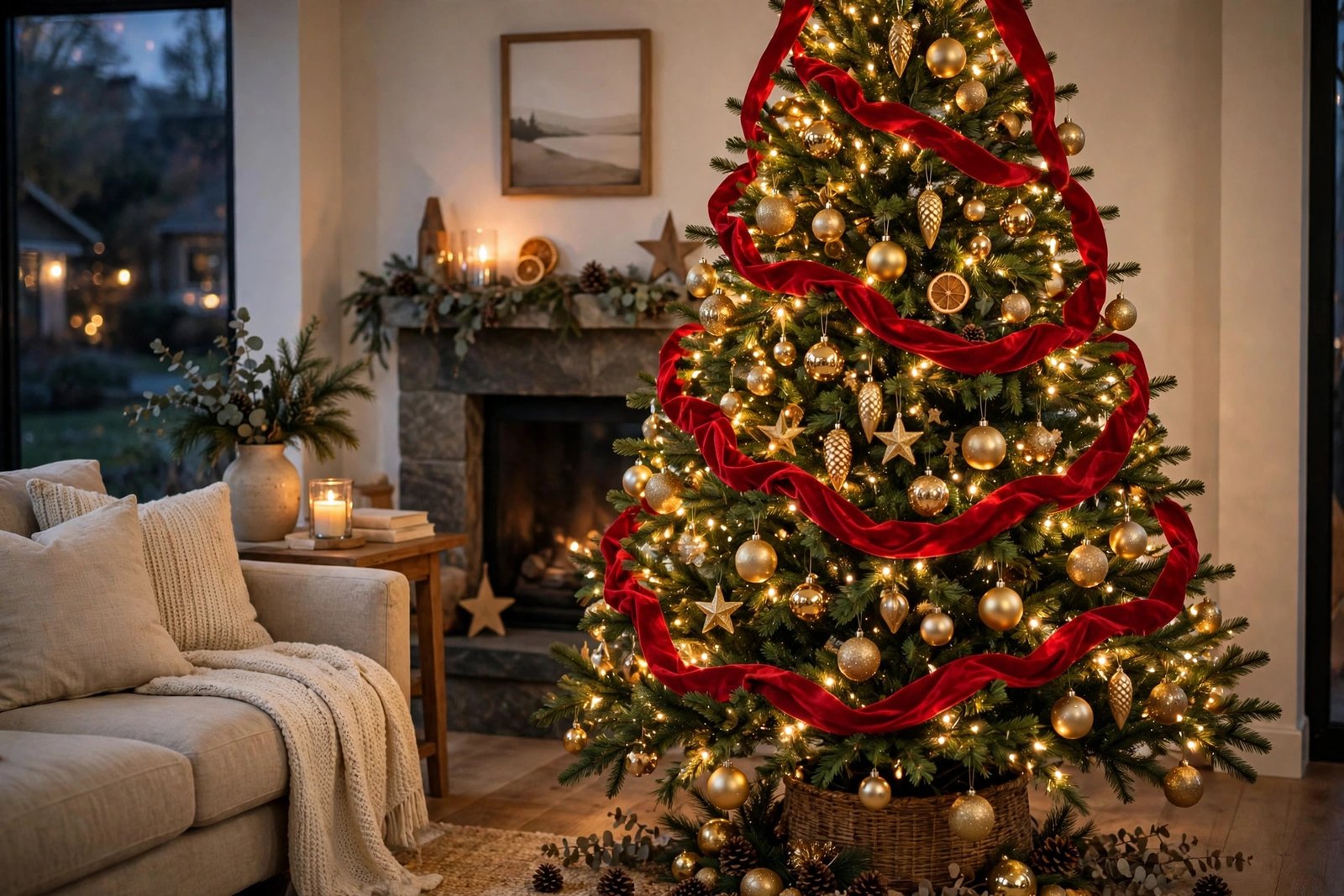
A ribbon garland is the fastest way to make a Christmas tree look professionally styled, because one continuous ribbon woven through the branches adds color, movement and fullness that ornaments alone cannot. Unlike a traditional beaded or tinsel garland, a ribbon garland is wide enough to be seen from across the room, soft enough to suit any style from farmhouse to formal, and cheap enough to change every year. This guide covers the ribbon types that hold their shape, the right widths and lengths for every tree size, the four application techniques decorators actually use, and the color pairings that make the garland and the ornaments work together instead of competing.
What Is a Ribbon Garland and Why Is It Trending?
A ribbon garland is simply ribbon used the way a garland is used — draped, spiraled or tucked around the tree in place of, or alongside, beads and tinsel. It has taken over from thin garlands because modern tree styling favors a few large, deliberate elements over many small ones, and nothing reads larger from a distance than a four inch ribbon catching the light. The technique also fixes thin trees: wide ribbon tucked between branches hides gaps and bare spots deep inside the tree, so the tree looks fuller before any ornaments go on. Ribbon is reusable for years, stores flat in a drawer, and comes in every color, pattern and finish, which is why searches for it climb every season as decorators look for one change that transforms last year’s tree. It pairs naturally with a color-led scheme like these red and white Christmas tree ideas, where the ribbon carries half the palette on its own.
Which Ribbon Types Work Best as a Tree Garland?
Wired ribbon is the professional standard, because the thin wire in its edges holds every loop, billow and cascade exactly where you place it, all season, without pins or ties. Velvet ribbon wired or not gives the richest, most traditional look and photographs deep and soft. Sheer organza ribbon adds a light, icy layer that glows when lights sit behind it, and works best layered over a solid ribbon rather than alone. Burlap and linen ribbons suit farmhouse and rustic trees and hide gaps brutally well because of their width and stiffness. Deco mesh is the budget volume option — very wide, very full, and best kept to playful, informal trees because it can overwhelm smaller ones. Whatever the material, buy ribbon on the spool with wired edges in at least a two and a half inch width for the main garland; narrow craft ribbon disappears into the branches and belongs in bows and accents instead. Craft stores stock every type in the seasonal aisle, and Christmas ribbon fills the shelves at Michaels from October onward.
How Much Ribbon Do You Need for Your Tree?
Underbuying ribbon is the most common garland mistake, so measure by tree height before shopping. As a working rule, a full cascade or spiral style needs roughly ten feet of wide ribbon per foot of tree height — about sixty to seventy feet for a standard six to seven foot tree, which usually means three to four standard spools. The tucked loop method uses less, around six feet per foot of height, because the ribbon travels in short pieces instead of one continuous run. Slim and tabletop trees need about half the full-tree amount, and very wide, dense trees can need a third more. Width matters as much as length: a four inch ribbon covers so much more branch that it often needs fewer total feet than a two and a half inch ribbon to achieve the same look. Buy one spool more than the calculation says — ribbon from the same dye lot matches perfectly, and leftover ribbon becomes bows for the wreath, the mantel and the gifts.

What Are the Main Ribbon Garland Techniques?
Four techniques cover nearly every styled tree you see. The cascade runs long lengths from the top of the tree downward, tucked in and out of the branches so the ribbon appears and disappears like water — formal, dramatic and the best choice for tall trees. The spiral wraps one continuous ribbon around the tree in a loose diagonal, evenly spaced, which is the fastest method and suits classic trees, following the same layering order as a standard how to decorate a Christmas tree sequence. The tucked loop method cuts the ribbon into two to three foot pieces, each formed into a soft loop or puff and pushed into the branches — it uses the least ribbon, hides gaps best and gives the fullest modern look. The bow method skips the garland line entirely and places individual bows at intervals through the tree, ideal when the ribbon is expensive or the tree is small. Whichever technique you choose, put the ribbon on after the lights and before the ornaments, and step back twice during the process to check the spacing from across the room.
How Do You Pair Ribbon With Ornaments and Colors?
The garland and the ornaments should divide the work: ribbon supplies the large color fields, ornaments supply the detail and sparkle. On a single color scheme, match the ribbon to the dominant ornament color and let the second color live in the baubles. On a two ribbon tree, layer a wide solid ribbon behind a narrower patterned one — solid velvet under a gingham, or plain red under a candy stripe — and keep every other element quieter. Metallic ribbons, gold especially, behave like jewelry: stunning in a spiral on a formal tree, but they reflect so much light that the ornaments should be mostly matte beside them. Patterned ribbon is the tree’s statement piece, so pair it with plain ornaments; plain ribbon can carry patterned, novelty and character ornaments without a fight. Carry one ribbon from the tree onto the mantel or the staircase and the whole room suddenly looks designed — the same crossover trick used in these Christmas mantle ideas.

How Do You Store Ribbon Garland After Christmas?
Ribbon survives storage better than almost any other decoration, as long as it is not crushed. Rewind each length onto its original spool or around a flat piece of cardboard, keeping the wired edges straight rather than folded, because a hard crease in wired ribbon never fully relaxes. If the ribbon was cut into loops, stack the pieces flat between tissue rather than balling them into a bag. Keep spools in a dry box away from attic heat, which makes cheap ribbon brittle and fades deep reds. Velvet ribbon should be rolled with its pile side out to avoid pressure marks. Labeled by tree and color, a ribbon collection lasts for many seasons, and most decorators find the second year’s garland faster than the first because the lengths are already cut to the tree.
Frequently Asked Questions
For cascades and spirals, yes — the wire is what holds the shape against gravity for six weeks. Unwired ribbon works for tucked loops and bows if it is stiff, like burlap, but soft satin without wire slides and flattens within days. When in doubt, buy wired; it is only slightly more expensive and far more forgiving.
Ribbon goes on after the lights and before the ornaments. It forms the background layer, and ornaments are then placed to sit in front of it, over it and in its gaps. Adding ribbon last forces you to work around fragile ornaments and the garland ends up sitting on the surface instead of woven through the tree.
Two and a half to four inches is the working range for a full size tree. Four inch ribbon makes the boldest, most modern statement and hides gaps best; two and a half inch ribbon suits slimmer trees and layered double ribbon looks. Tabletop trees take one and a half inch ribbon so the garland stays in proportion.
It can carry a tree surprisingly far — a full ribbon cascade with lights and a topper already looks finished, and many minimalist trees stop there. Most trees still look richer with at least a simple set of baubles in front of the ribbon, but ribbon plus lights is a complete, respectable look on a budget or a tight schedule.
Tuck each loop or billow deep into the branches and bend a branch tip gently over the ribbon to lock it, rather than tying or pinning. On spirals, anchor the ribbon at the back of the tree at each turn. Wired ribbon holds its own grip once shaped; slipping is almost always a sign the ribbon is sitting on the surface instead of woven in.
Yes — ribbon is one of the most reusable decorations there is. Rewind it onto spools or cardboard, store it flat and dry, and it returns season after season. Wired edges may need gentle reshaping the second year, and velvet benefits from a light steam to lift the pile before it goes back on the tree.

At Decor Artly, we bring art, home decor, and personal style together to create beautiful spaces and inspiring lifestyles. Led by Design Director Roni, we offer curated artwork, elegant home accents, and personalized styling to help you express your unique taste.
Pingback: Christmas Tree Topper
Pingback: Christmas Wreath
Pingback: Christmas Wreath Sash
Pingback: Christmas Garland