
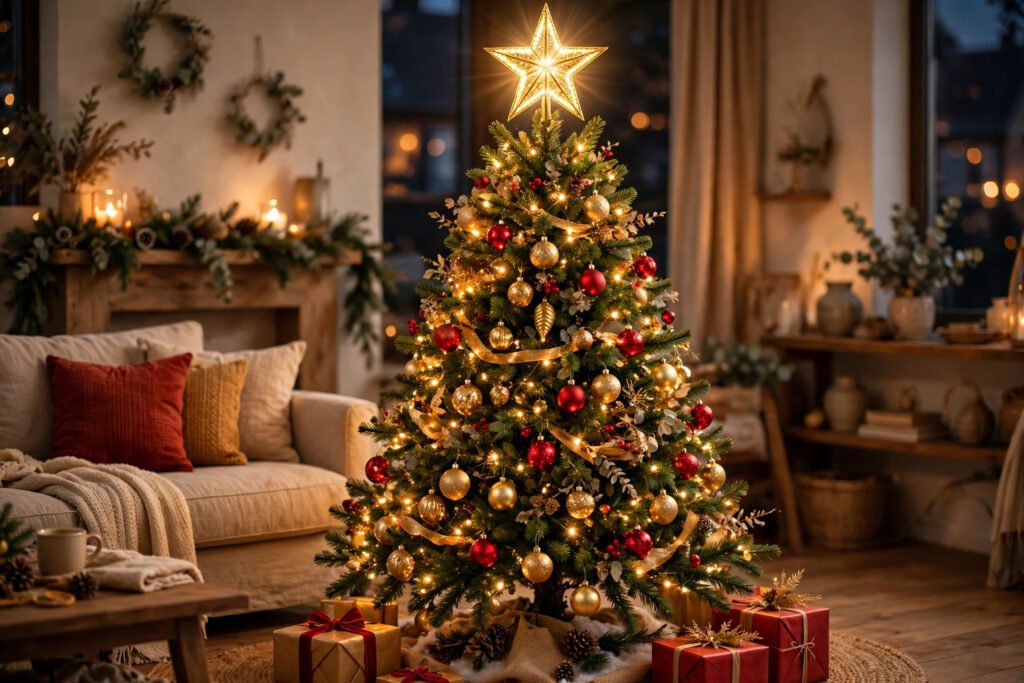
A Christmas tree topper is the full stop at the end of the tree’s sentence — the one piece every eye lands on, and the one most often chosen last, in a hurry, at the wrong size. Get it right and the whole tree looks finished; get it wrong and even a beautifully decorated tree reads as almost done. This guide covers the classic and modern topper styles, the sizing rule decorators actually use, and the fixes for the two problems everyone meets — a topper that leans and a topper that dwarfs or disappears into the tree.
What Are the Most Popular Christmas Tree Topper Styles?
The most popular Christmas tree topper styles are the star, the angel, the oversized bow, the finial or spire, and modern alternatives such as a floral spray, a snowflake or a cluster of picks and ornaments wired at the crown. Stars and angels split the traditional vote almost evenly — the star for its clean silhouette against a lit tree, the angel for households where the topper is a family heirloom with a story. Bows have surged with the ribbon-heavy trees of the last few seasons, because a bow can be made from the same ribbon that runs through the branches, making the top of the tree match its middle exactly.

Choose by the tree’s own style rather than by habit. The restrained, natural trees in our Nordic Christmas decorations guide take a simple wooden or paper star better than a glittering finial, while a lush traditional tree carries the ornate pieces. A topper in the tree’s accent metal — gold tree, gold star — looks deliberate; a topper that introduces a brand-new color at the very top looks like an afterthought, which, if we are honest, it often was.
How Big Should a Christmas Tree Topper Be?
A Christmas tree topper should be roughly in proportion to the tree’s height — about 8 to 12 inches tall for a standard 7 to 7.5 foot tree, smaller for tabletop trees and larger, up to 16 inches or more, for trees over 9 feet. The working rule is that the topper should look like the tree’s crown, not its hat: wide enough to balance the tree’s widest branches when you squint at the whole silhouette, and never so heavy that the top branch bends under it. When in doubt between two sizes, decorators choose the larger one — an undersized topper is the one that reads as a mistake.
Height is only half of it; visual weight is the other half. A wire-frame star and a solid ceramic angel of the same height do not weigh the same on the eye — the angel reads twice as large. Match a light, open topper to a slim or sparse tree and a solid, detailed topper to a full one. Leave a hand’s width of clear space between the topper and the ceiling: a topper that nearly touches the ceiling makes the whole tree look squeezed into the room, which is also why the topper’s height belongs in the math before you buy the tree, not after.
How Do You Stop a Christmas Tree Topper From Leaning?
You stop a Christmas tree topper from leaning by strengthening the top branch — slide the topper’s cone or stem over the leader branch and a second branch together, wrap floral wire or a zip tie around the base, or thread a thin wooden dowel inside a hollow topper and tape it to the trunk. Almost every leaning topper is a weak-top-branch problem, not a topper problem: the single thin leader at the crown of most artificial and real trees was never built to hold weight at an angle. Give the topper two supports and the lean disappears.
Work from the back so the fix never shows. On an artificial tree, bend the top two branches upward together to form a thicker post and wire the topper to both. On a real tree, trim the leader to a sturdy six inches and set the topper deep over it. The spiral and cascade techniques in our Christmas tree ribbon garland guide end at the crown for a reason — ribbon tails and picks tucked around the topper’s base hide every wire, cone and dowel, so the strongest fix is also invisible from the front.
Which Christmas Tree Topper Suits Your Tree Theme?
The Christmas tree topper that suits your tree theme is the one that repeats the tree’s main material or accent color at the crown — a star in the same metal as the ornaments, a bow in the same ribbon as the garland, or an angel dressed in the palette’s lead color. Themes break at the top more than anywhere else, because the topper is bought separately and stored separately. Run the same test as the palette trees in our red and white Christmas tree ideas: a red-and-white tree wants a red bow, a white star or a silver finial — a rustic burlap bow on that tree would clash at the exact spot everyone looks first.

A few pairings never miss. Glamorous trees take crystal, mirrored or metallic finials and spires. Farmhouse trees take galvanized stars, burlap or plaid bows and wooden beads worked into a spray. Whimsical trees — the kind covered in color and character — take the playful toppers: a Santa hat, a cluster of oversized candy picks, a top hat. Traditional trees take the angel or the Bethlehem star and should not be talked out of them; some pieces are classics because they finish the oldest story the tree tells. Whatever the theme, buy the topper with the decorations in front of you, not from memory in a shop aisle.
How Do You Make a DIY Christmas Tree Topper?
You make a DIY Christmas tree topper by building a light shape around a cone or a sturdy base — a paper or wooden star, a ribbon bow with long tails, or a spray of picks, feathers and ornaments wired to a floral cone that slides over the top branch. Lightness is the whole craft: a homemade topper fails by weight, not by looks, so cardboard, paper, ribbon and faux greenery outperform anything solid. The bow is the beginner’s best project because the method is identical to tying gift ribbon, just bigger — wide wired ribbon, loops pinched at the center, tails left long to trail into the branches.
A star is the second project: two layers of stiff card or thin craft wood, glued, painted gold or white and glittered only if the tree already sparkles. The shaping skills in our how to decorate Christmas tree guide — wiring picks at angles, fluffing and layering — build a spray topper in minutes: five to seven picks fanned around a cone read as a designer finish and cost a fraction of one. Make the topper in the tree’s palette, test its weight on the top branch before the final glue, and store it in its own small box — the topper is the first thing on and the last thing protected.
When Do You Put the Christmas Tree Topper On?
You put the Christmas tree topper on last in sequence but test-fit it first — decorators set the topper briefly before decorating to check the total height against the ceiling, remove it, decorate lights-to-ornaments, and finish by crowning the tree. The test fit is the step home decorators skip and regret, because a tree chosen to fit the room sometimes fits only without its topper. Decorating order matters for a practical reason too: the topper is the most fragile piece, and putting it on early means a month of decorating knocks waiting to happen.
Buy with the same discipline: toppers sell out in the good sizes by early December, and the seasonal displays at craft stores such as Michaels are where the proportion rule stops being theory — hold the topper at arm’s length against a display tree of your tree’s height and squint at the silhouette. If the crown looks balanced from across the aisle, it will look balanced in your living room. Then bring it home, test-fit it, and let it wait in its box for its one job: being the last thing on, and the first thing seen.
The angel and the star are the most traditional Christmas tree toppers, both rooted in the nativity story — the angel for the Annunciation and the star for Bethlehem. Angels dominated Victorian trees, while stars became the most common choice through the twentieth century and remain so today.
A tree topper for a 7 foot tree should be about 8 to 12 inches tall. Within that range, match the visual weight to the tree: a full tree carries a solid 12-inch topper, while a slim tree suits a lighter, more open design at the smaller end of the range.
Your Christmas tree topper keeps falling over because the single top branch is too weak to hold it upright. Slide the topper over two branches instead of one, or secure its base to the trunk with floral wire or a zip tie hidden behind the topper, and the lean and falls stop.
Yes, a Christmas tree can have no topper — many modern and minimalist trees finish the crown with a cluster of picks, a bow set slightly lower, or simply the shaped top branches. The rule is that the crown must look deliberately finished; a bare, sparse top is what reads as unfinished.
Instead of a traditional tree topper you can use an oversized ribbon bow, a floral or greenery spray, a Santa hat, a top hat, a snowflake, or a cluster of large ornaments wired at the crown. The most convincing alternatives repeat a material or color already used in the tree.
Store a Christmas tree topper in its own rigid box or a box with dividers, wrapped in tissue, kept off the floor of any storage pile. Toppers are the most fragile decoration most households own, and a dedicated box is why heirloom angels and glass finials survive decades of Decembers.

At Decor Artly, we bring art, home decor, and personal style together to create beautiful spaces and inspiring lifestyles. Led by Design Director Roni, we offer curated artwork, elegant home accents, and personalized styling to help you express your unique taste.
Pingback: Christmas Tree Skirt