
Horror Halloween Costumes Ideas, Budgets and Tips for Every Skill Level
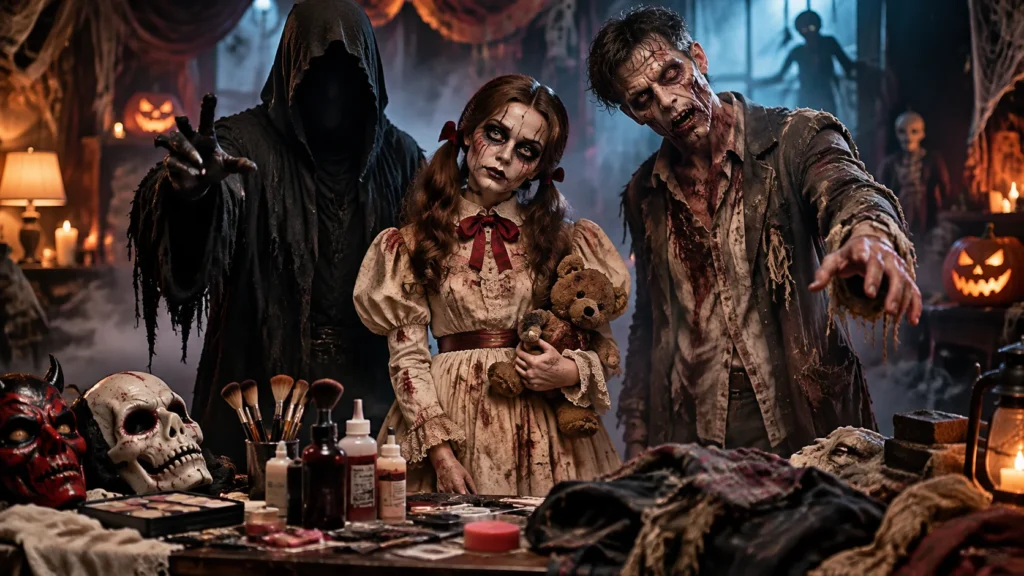
Horror Halloween costumes are the ones people still talk about the next morning. A clever pun costume gets a laugh and is forgotten by ten o’clock, but a figure standing perfectly still at the edge of the room is remembered. This guide is for first-timers on a thrift-store budget and for hobbyists who already own a tub of spirit gum.
You will learn how to choose a concept, what to spend, how makeup, masks and prosthetics compare, and how to avoid the mistakes that leave you sweaty and half-blind by 9 p.m.
Quick Answer
The best horror Halloween costumes rely on a strong silhouette, one unsettling detail and a committed performance, not on piles of fake blood. Beginners can succeed with a faceless figure, a possessed doll, a classic zombie or a simple movie-monster tribute. Most take under an hour and under $30. Pick one idea, test the comfort and visibility, and practice how you will move.
What Makes a Scary Costume Work
Gore is easy to buy. Dread is harder. People react most strongly to wrongness: a familiar shape that behaves incorrectly, a face that doesn’t quite look like a face, a figure that is too still. That is why the strongest horror Halloween costumes are built around one clear idea instead of a pile of accessories.
A useful test is to describe your costume in five words. “Waterlogged ghost in a wedding dress” works. “Zombie clown pirate doctor” does not, because the more you add, the less anything reads as frightening.
Silhouette Before Detail
Judge your look from across the room, in dim light, before you add a single detail. Fear starts with shape: an unnaturally tall figure, a hunched posture, long dark hair hanging over the face, a hooded outline. Many horror Halloween costumes fail at distance because they were designed for a close-up photo. Fine prosthetic textures and small props vanish at a party, while a distinctive outline is visible instantly.
A practical shortcut is to take a photo of yourself against a dark wall with the flash off. If you can’t tell what you are, simplify the shape.
Movement, Sound and Behavior
A costume becomes frightening when it behaves. A slow head tilt, a rigid walk, or a habit of watching people without blinking can be scarier than any makeup. Silence helps too. Many classic movie villains, including Michael Myers, are unsettling partly because they don’t talk.
Keep the performance sustainable, though. If you can’t hold the character for four hours, pick one or two signature behaviors and drop them when you need a break.
Horror Halloween Costumes That Work for Beginners
Beginners often assume that scary means expensive and complicated. In practice, the easiest horror Halloween costumes rely on clothing you already own, one strong face treatment and a little discipline. The goal is a finished look that survives a crowded, warm room, not a film-quality creation.
Choose based on how much face coverage you are comfortable with. A mask is the fastest and needs no skill. Makeup is cheaper but takes practice. A “faceless” or hidden-face approach needs only fabric.
Ideas You Can Finish in an Hour
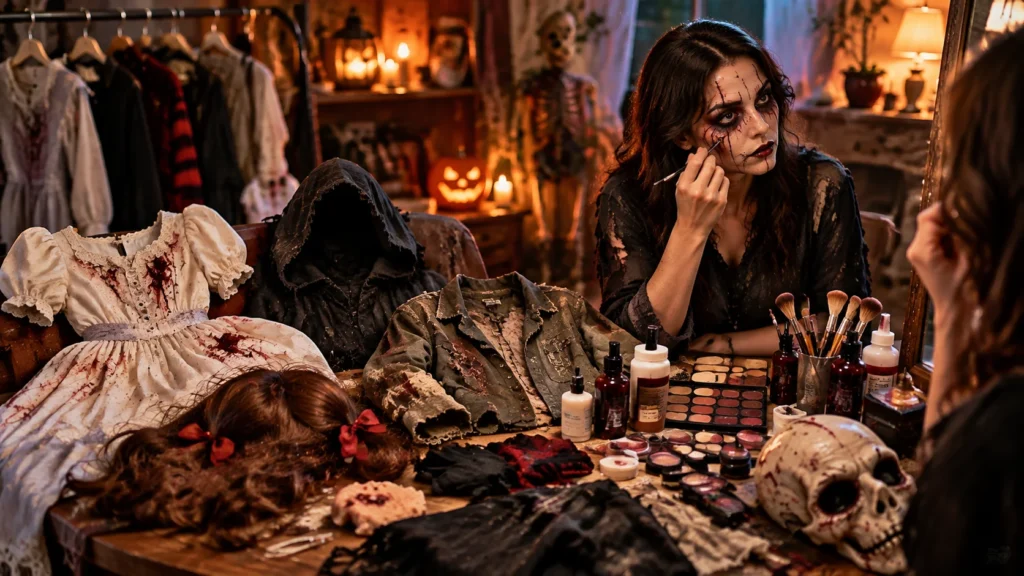
- Faceless figure: Dark clothes, a stretchy hood or sheer fabric over the face, and slow movement.
- Possessed doll: A vintage-style dress, pale base makeup, painted cheek circles and a stiff, jerky walk.
- Basic zombie: Torn thrift clothes, grey-green face paint, dark eye shadow and a little fake blood at the collar.
- Drowned ghost: Soaked-looking white clothes (spray with a water bottle just before leaving), pale makeup and wet-look hair.
- Scarecrow gone wrong: Flannel, straw tucked into sleeves, stitched mouth drawn with eyeliner.
Classic Movie Monsters Done Simply
Recognizable characters work well because guests understand them instantly. Think Ghostface, Michael Myers, Jason Voorhees, Freddy Krueger, Pennywise or The Nun. The trick for beginners is to use the identifying elements rather than a perfect replica: Michael Myers is a pale mask and dark coveralls, Freddy is a striped sweater and a worn hat, and The Nun is a habit with pale, stern makeup.
Licensed costumes from retailers are the simplest route. If you build your own, treat it as inspired by the character and avoid selling it. For personal use at a party, this is rarely an issue, but commercial use of a character’s likeness can involve trademark and copyright concerns, so check the rules before selling anything.
Choosing a Look by Budget
Spending more rarely makes a scarier outfit. A careful $25 costume often beats a rushed $90 purchase. These tiers help you decide where money actually matters in horror Halloween costumes.
Horror Halloween Costumes Under $30 From Thrift and Home
Start at a thrift store, not a costume shop. Old suits, nightgowns, lab coats and work shirts are cheap, and they look authentically worn. Tear the hems, rub in dirt-colored powder or tea, and you have a convincing zombie, ghost or survivor look.
At home you probably already have most of the rest:
- Black and brown eyeshadow for sunken eyes
- White or grey face paint, or cheap cream makeup
- Cornstarch, cocoa and corn syrup for a basic fake-blood recipe (a food coloring stain risk, so test on a fabric corner)
- Old stockings or a stretchy hood to cover the face
- A flashlight for dramatic lighting
Mid-Range and Premium Spending
At $30-$80, the best upgrade is usually a good mask or a quality wig, since these change your silhouette. Higher-end horror Halloween costumes often include silicone prosthetics, which look excellent but need adhesive, patience and careful removal. Premium items are worth it when you will wear them more than once, such as for a haunted house job, a convention or a themed party you attend every year.
Skip premium spending when you are a beginner, plan to dance, or expect a hot room. An expensive prosthetic that peels off in an hour is wasted money.
Makeup, Masks and Prosthetics Compared
| Option | Cost | Skill needed | Comfort | Best for |
|---|---|---|---|---|
| Face paint/makeup | Low | Medium | Good, but can smear | Zombies, dolls, ghosts |
| Full mask | Low-medium | None | Hot, limited vision | Movie slashers, fast looks |
| Silicone/latex prosthetics | Medium-high | High | Fair, takes time | Realistic wounds, creatures |
| Fabric/hood approach | Low | None | Good | Faceless and uncanny looks |
In practice, makeup gives the most flexibility for the least money, while masks win on speed. A common beginner mistake is choosing prosthetics for a night that involves eating, drinking and sweating. If you do use them, apply a primer, set with powder, and carry a small repair kit with adhesive and a mirror.
Group and Couple Ideas
Groups multiply the effect, because a coordinated set of figures looks planned and unsettling. Try a family of “portrait ghosts” in matching old-fashioned clothes, a group of identically masked slashers, a “haunted dinner party” where everyone is a different type of ghost, or a camp-counselor survivor squad with a single villain trailing behind.
For couples, a contrast works well: one person as a monster and the other as a “victim” with torn clothes, or two figures that are the same creature at different stages. These horror Halloween costumes photograph better when both people share a color palette. Keep the group’s effort level matched, because one polished costume next to a half-finished one weakens the whole picture.
Practical Examples
These are hypothetical scenarios to show how decisions play out, not reported cases.
Scenario 1: The last-minute guest. It is 5 p.m., the party is at 8, and you have $20. A thrift-store nightgown, grey face paint and messy hair give you a ghost. Spend the leftover time on posture and a slow walk, not more makeup.
Scenario 2: The office party. Workplaces often limit gore, weapons and anything that hides your face. A “creepy doll” with pale makeup, rosy cheek circles and a stiff walk is scary but acceptable. Always confirm the dress code first.
Scenario 3: The all-night house party. You will be hot, social and holding a drink. Choose a hood-and-fabric approach or light makeup over a full latex mask. Comfort lets you stay in character far longer, which makes it scarier in the end.
Safety, Comfort and Party Rules
Safety is the gap most competing guides skip, and it matters.
- Patch-test makeup. Apply a small amount on your inner arm a day before to check for reactions. Use products labeled for skin, and avoid craft paint on the face.
- Check your vision. A mask that blocks your peripheral view is a hazard on stairs, in crowds and near roads.
- Watch flammability. Loose synthetic fabric, wigs and fog or candles do not mix. Keep away from open flames.
- Be careful with props. Realistic weapons can alarm other guests or breach venue rules. Make them obviously fake, or skip them.
- Respect others. Don’t touch or chase people who haven’t agreed to it, and drop the act if someone is genuinely frightened.
- Remove makeup properly. Use a gentle cleanser or the remover recommended by the product, not harsh scrubbing.
Common Mistakes
- Doing too much. More details usually mean less impact.
- Ignoring the silhouette. A great face means nothing if the outline is forgettable.
- Testing nothing. Many costumes fail because of comfort problems that a ten-minute trial would have exposed.
- Using blood everywhere. Fake blood on every surface looks cartoonish. Place it where it would plausibly appear.
- Wearing it all night without breaks. Heat, fogged vision and thirst ruin the evening.
- Forgetting the venue. Schools, workplaces and some public events have costume rules.
Expert Tips
- Add a single “wrong” detail, such as eyes that don’t match or clothes from the wrong era, rather than many.
- Use dim, low-angle light when taking photos. It hides makeup edges.
- Layer base colors: grey-green under red on skin looks more convincing than flat red.
- Practice your walk in front of a mirror.
- Pack an emergency kit: adhesive, wipes, safety pins, a small mirror and a spare hair tie.
- Do the full makeup once at least two days beforehand so mistakes aren’t discovered at the party.
FAQs
A zombie, faceless figure, drowned ghost, possessed doll or scarecrow. Each uses thrift clothes and basic makeup and can be done in under an hour.
Choose one clear idea, focus on silhouette and movement, and avoid cluttering the outfit with props. Slow, controlled behavior helps more than loud gestures.
It depends on the child’s age and sensitivity. Choose milder looks, such as friendly ghosts or silly skeletons, and avoid heavy gore, restricted vision or realistic weapons.
Thrift-store clothing, face paint or cheap cream makeup, and homemade effects. A strong concept costs far less than a store-bought premium set.
A common home mix is corn syrup, red food coloring and a thickener such as cornstarch, with a little cocoa for a darker shade. Test on fabric, keep it away from eyes, and never use it on broken skin.
Often only with restrictions. Many places ban weapons, face coverings and graphic gore, so ask about the rules in advance.
Choose breathable fabric, avoid heavy masks in warm rooms, drink water, and plan short breaks. A simpler look is always easier to maintain.
Coordinated sets work best, such as portrait ghosts, matching masked slashers or a haunted dinner party. Keep effort levels and color palettes consistent.
Final Takeaway
The scariest horror Halloween costumes are rarely the costliest. They are the ones with a clear concept, a distinctive outline and a performer who commits to the role. Decide on a single idea, build it from inexpensive pieces, test it for comfort and vision, and practice how you will move. Start with one of the one-hour ideas above, and you will arrive ready to be remembered.
At Decor Artly, we bring art, home decor, and personal style together to create beautiful spaces and inspiring lifestyles. Led by Design Director Roni, we offer curated artwork, elegant home accents, and personalized styling to help you express your unique taste.