
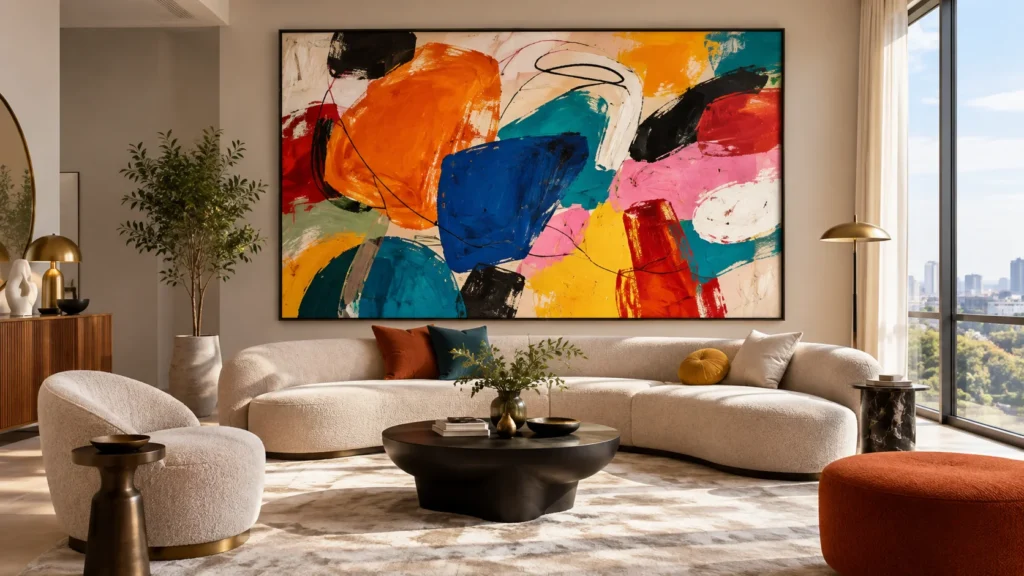
Committing to a big, bold, playful piece of art for your living room is a genuinely different decision than picking a small, safe print for a hallway. It’s more visible, more expensive to get wrong, and it says a lot more about the room’s whole personality. This guide breaks down what actually makes wall art read as “funky” rather than just busy, how to size and place a large piece correctly, and how to make sure a bold statement piece still feels like part of a livable, cohesive room rather than something fighting against the rest of your decor.
Quick Answer: What Makes Wall Art “Funky”?
Funky wall art is generally defined by bold, unconventional color choices, playful or unexpected pattern and shape, and a sense of personality or humor that sets it apart from more traditional, muted decor. For a living room specifically, going large with a funky piece works best when the rest of the room has enough visual “breathing room” — simpler furniture, more neutral walls, or a restrained color palette elsewhere — so the art has space to be the clear focal point rather than competing with an already busy room.
What Makes Wall Art “Funky”?
“Funky” is a genuinely subjective term, but a few recurring qualities show up consistently in art described this way: bold, saturated, or unexpected color combinations (think clashing brights rather than a soft, coordinated palette); playful or abstract shapes rather than realistic, literal subject matter; a sense of energy or movement in the composition; and often a hint of humor or irreverence that separates it from more formal, traditional art styles.
This is different from simply “colorful” or “bold” art — a piece can be bright and saturated without necessarily reading as funky if it’s still fairly structured or serious in composition. Funky art tends to feel looser, more expressive, and less concerned with conventional “good taste” rules, which is exactly what makes it such an effective way to give a living room genuine personality rather than a safe, showroom-style look.
Choosing the Right Size for Your Living Room
Getting the size right matters more with a bold, statement-style piece than it does with a quieter, more neutral one, since a funky piece that’s too small can look like an odd, disconnected accent, while one that’s genuinely well-scaled becomes the room’s clear anchor.
As a general starting guideline, a piece intended as a living room focal point should span roughly two-thirds to three-quarters of the width of the furniture beneath it — a sofa, console table, or media unit, for example. For an empty wall without furniture directly below it, aim for a piece that fills a meaningful portion of the available wall space rather than looking like a small object floating in a large expanse.
It’s also worth accounting for viewing distance specifically because of how bold, detailed funky pieces tend to be. In a larger, more open living room where the art will typically be viewed from across the room, a bigger, bolder piece with more visual complexity works well. In a smaller or more compact living room where the art is viewed up close, an oversized, highly detailed piece can start to feel overwhelming rather than striking — in that case, scaling back slightly on complexity while keeping the size ambitious tends to work better.
Funky Styles and Themes to Consider
Within the broad “funky” category, a few recognizable style directions come up repeatedly:
- Abstract and expressive — bold color fields, loose brushwork, and non-representational composition, offering energy without depicting a specific recognizable subject.
- Pop art-inspired — bright, graphic, high-contrast pieces often featuring simplified shapes or playful cultural references.
- Psychedelic and pattern-heavy — swirling shapes, saturated gradients, and dense pattern work that leans into visual movement and intensity.
- Retro and vintage-inspired funky — bold color combinations and shapes reminiscent of specific past decades (particularly the 1960s and 1970s), reinterpreted with a modern edge.
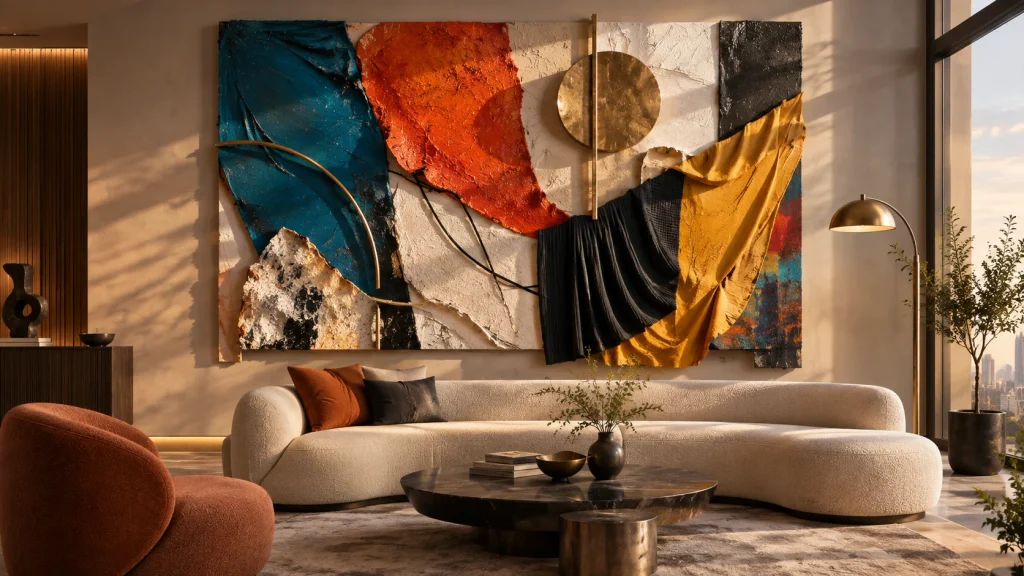
- Mixed-media and textural funky — pieces incorporating unconventional materials (fabric, found objects, dimensional elements) alongside paint or print, adding a tactile, unexpected quality beyond color and shape alone.
Choosing among these often comes down to which one complements your existing furniture style most naturally — a mid-century modern living room, for instance, tends to pair especially well with retro or pop art-inspired funky pieces, while a more contemporary, minimal space can handle bolder abstract or psychedelic pieces as a striking contrast.
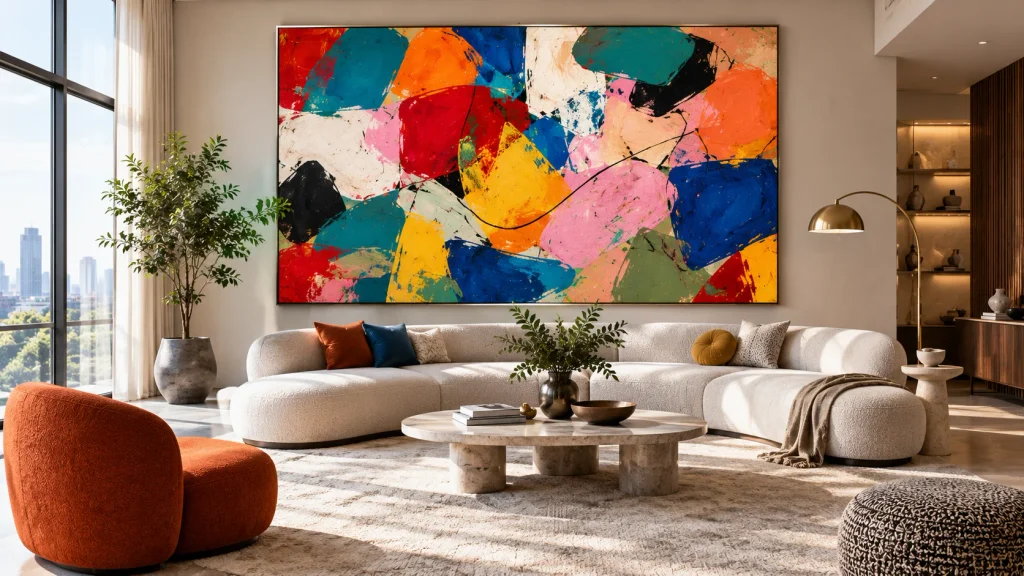
Color and Pattern: Making Bold Choices Work in a Living Space
The biggest risk with funky wall art in a living room isn’t choosing something too bold — it’s choosing something bold that clashes with, rather than complements, the room’s existing color story. A practical approach many designers use is to pick out one or two colors from the artwork and echo them in a smaller way elsewhere in the room (a throw pillow, a vase, a rug accent), which visually ties the piece to the rest of the space rather than leaving it feeling like an isolated addition.
Pattern works similarly. A heavily patterned funky piece generally reads best against a relatively calm, uncluttered backdrop — solid or lightly textured walls, simpler furniture silhouettes — rather than competing with an already pattern-heavy room. This is part of why funky, maximalist art often works surprisingly well in otherwise fairly minimal or neutral living rooms: the contrast lets the art do the visual work without the room feeling chaotic overall.
Materials and Mediums for a Statement Piece
Large funky wall art comes in a range of mediums, each contributing a different feel to a living room. Canvas prints and original paintings remain the most common choice, offering flexibility in both color intensity and finish (matte, glossy, or textured). Metal wall art, often laser-cut into bold shapes or abstract forms, adds a more sculptural, dimensional quality and tends to catch light in a way that flat canvas doesn’t. Mixed-media and textile-based pieces — incorporating fabric, macramé, or dimensional elements — bring a tactile, layered quality that can make a piece feel even more distinctly “funky” and unconventional compared to a standard flat print.
If you’re choosing between mediums, consider how much visual weight and texture you want the piece to add beyond color alone — a heavily textured or dimensional piece will read as more prominent and tactile in the room than a flat print of similar size and color intensity.
Large Funky Wall Art for Living Room: Best Placement Ideas
Placement is where a lot of otherwise great funky wall art choices go wrong, so it’s worth being deliberate here. The most common and generally most effective placement is above a sofa or main seating area, where the piece becomes the room’s natural visual anchor and benefits from the furniture below providing a grounding base.
An empty accent wall — one without windows, doors, or built-in shelving breaking up the space — is another strong option, particularly for a piece meant to be the singular focal point of the room rather than one element among several. This works especially well in more open-plan living spaces where the art needs to hold its own visually from a distance.
Avoid placing a large funky piece directly next to or competing with another strong visual element in the room, such as a bold accent wall color, a large mirror, or another substantial piece of art — without enough visual breathing room, both elements tend to diminish each other rather than working together. If your living room already has other prominent design features, positioning the funky piece on its own wall, away from that competition, generally produces a more cohesive result.
How to Pair Funky Art with Existing Decor
A genuinely bold, funky piece doesn’t require your entire living room to match its intensity — in fact, the opposite is usually true. Pairing a statement piece with simpler, more neutral furniture and decor elsewhere in the room lets the art carry the visual energy without the space feeling overwhelming or cluttered.
A useful mental framework here: think of the room as having one clear “loud” element and everything else playing a supporting, quieter role. If your funky wall art is the loud element, keep upholstery, rugs, and other large decor pieces relatively restrained in color and pattern. If you already have several bold elements in the room (a patterned rug, colorful furniture), a funky piece can still work, but it benefits from sharing a cohesive color family with those existing elements rather than introducing a completely unrelated palette.
Common Mistakes to Avoid
Choosing a piece that’s technically large but still visually small for the wall. A common mistake is measuring the piece itself without accounting for how much empty wall space surrounds it — a large piece on an even larger wall can still look under-scaled.
Ignoring the room’s existing color story entirely. Funky doesn’t mean disconnected — pulling even one or two colors from the piece into the rest of the room helps it feel intentional rather than randomly placed.
Overcrowding the wall with additional decor. A large statement piece generally works best with some surrounding negative space; adding shelves, additional smaller art, or other decor too close to a large funky piece can undercut its impact as a focal point.
Underestimating how a bold piece reads at different times of day. Lighting changes how saturated colors and patterns appear; if possible, view a potential piece (or a photo of it in a similar lighting setup) under both natural daylight and your room’s evening lighting before committing.
Expert Tips for Choosing a Piece You’ll Love Long-Term
- If you’re unsure about committing to a very bold piece, start with a slightly more restrained “funky-adjacent” option (a single bold abstract shape rather than a dense, highly patterned composition) — you can always add a bolder piece elsewhere once you’re confident in the room’s overall direction.
- Use painter’s tape to outline the piece’s actual dimensions directly on your wall before ordering, which gives a far more accurate sense of scale than judging size from a product photo alone.
- If your living room already has a fairly neutral palette, treat that as an advantage rather than something to “fix” before adding funky art — a calm backdrop is often exactly what lets a bold piece stand out effectively.
- Photograph potential pieces styled in your actual space (using a printout or digital mockup at the correct scale) before finalizing a purchase, since colors and patterns can read very differently in a product photo than in your specific room’s lighting.
Frequently Asked Questions
What size wall art is considered “large” for a living room? There’s no single fixed number, but as a general guideline, a piece intended as a living room focal point should span roughly two-thirds to three-quarters of the width of the furniture beneath it, or fill a meaningful portion of an empty accent wall.
Can funky, colorful wall art work with neutral furniture? Yes — in fact, a neutral or restrained furniture palette often makes bold, funky art more effective, since it gives the piece visual space to stand out as the room’s clear focal point rather than competing with other bold elements.
Where should I hang large statement wall art in a living room? Above a sofa or main seating area is the most common and generally most effective placement, since the furniture below provides a grounding base for the piece. An empty accent wall without windows or shelving is another strong option.
What styles count as “funky” wall art? Common funky styles include abstract and expressive pieces, pop art-inspired work, psychedelic or heavily patterned pieces, retro/vintage-inspired designs, and mixed-media or textural artwork — all generally characterized by bold color, playful shape, and a sense of energy or personality.
How do I make sure a bold piece doesn’t clash with my room’s existing colors? A common approach is pulling one or two colors directly from the artwork and echoing them in smaller decor elements elsewhere in the room, which visually ties the piece to the space rather than leaving it feeling disconnected.
Is it okay to have funky wall art in a small living room? Yes, though it’s worth scaling back slightly on visual complexity if the piece will be viewed up close, since a highly detailed, oversized piece can feel overwhelming in a compact space even if the color and boldness themselves work well.
Should funky wall art match my other decor exactly? No — exact matching often looks flat and overly coordinated. Sharing one or two colors or a general mood with the rest of the room tends to work better than trying to match everything precisely.
What materials work best for a large funky statement piece? Canvas and original paintings remain the most common and versatile choice, while metal wall art adds a more sculptural quality and mixed-media or textile pieces add tactile, dimensional interest — the right choice depends on how much visual and physical texture you want beyond color alone.
Can I hang more than one large funky piece in the same living room? It’s possible, but it requires careful color and spatial planning so the pieces complement rather than compete with each other; for most living rooms, one clear large statement piece paired with simpler supporting decor tends to be easier to get right.
How do I know if a piece is “too much” for my space? If you find yourself needing to significantly simplify or remove other decor just to make the piece work, or if early impressions feel overwhelming rather than energizing, it may be worth considering a slightly less intense version of the style rather than abandoning the funky direction entirely.
Final Takeaway
Choosing large funky wall art for a living room comes down to balancing boldness with intention — getting the scale right for your specific wall and furniture, letting the piece’s colors echo elsewhere in the room in small doses, and giving it enough visual breathing room to actually function as a focal point rather than one more busy element in an already busy space. Start by taping out the piece’s actual dimensions on your wall before buying, and let that real-world scale check guide your final decision more than any product photo can.

At Decor Artly, we bring art, home decor, and personal style together to create beautiful spaces and inspiring lifestyles. Led by Design Director Roni, we offer curated artwork, elegant home accents, and personalized styling to help you express your unique taste.