
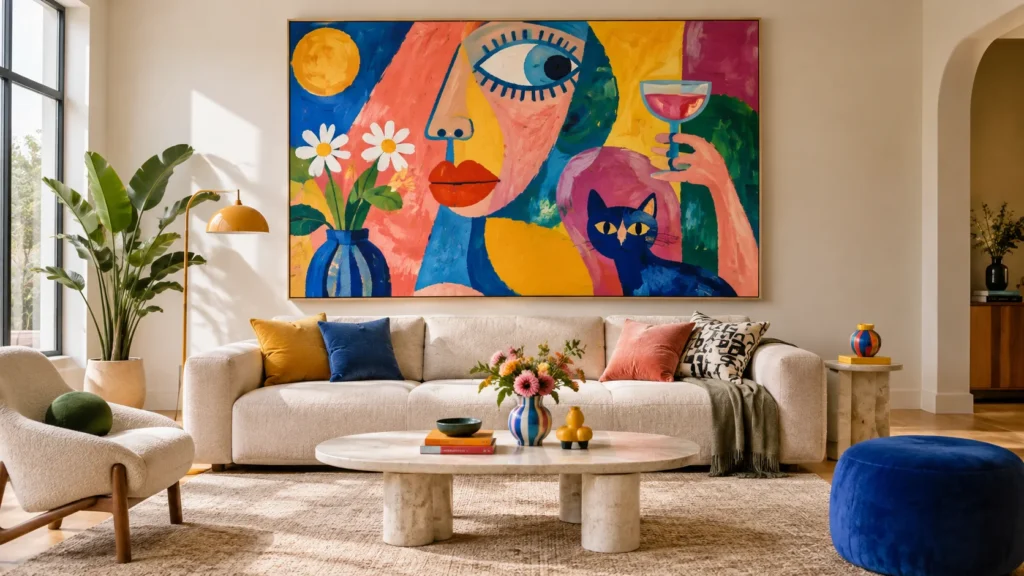
“Funky art” gets used constantly in decor and gallery listings, but it rarely comes with a clear definition attached. This guide breaks down what actually makes a piece read as funky rather than just colorful or busy, where to actually find and buy it, and how to style it without it feeling chaotic.
Quick Answer: What Defines Funky Art?
Funky art is generally defined by bold, unconventional color choices, playful or unexpected shapes, and a sense of energy or humor that sets it apart from more traditional, restrained styles. It overlaps with categories like pop art, psychedelic art, and maximalist decor, but isn’t identical to any single one of them — “funky” describes a loose, expressive tone rather than a strict technical movement.
The Origins and Core Traits of Funky Art
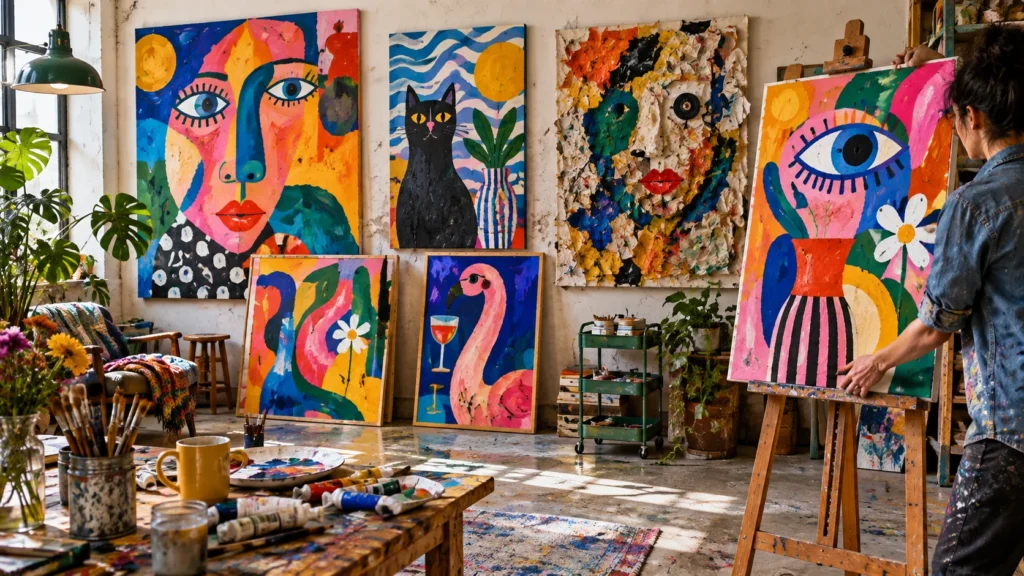
The term “funky” originated in music before crossing into visual art and design, carrying with it a similar sense of looseness, rhythm, and irreverence. Applied to visual art, it generally describes work that prioritizes expressive energy over formal precision — bold, saturated colors used in unexpected combinations, playful or abstract shapes rather than strict realism, and a general sense that the piece isn’t overly concerned with conventional “good taste” rules.
This is different from simply being “colorful” or “bold.” A piece can be bright and saturated while still feeling structured and serious; funky work tends to feel looser and more expressive, often carrying a hint of humor or irreverence that gives it personality beyond color alone. It frequently overlaps with pop art (bold, graphic, culturally referential), psychedelic art (swirling shapes and intense color gradients), and mixed-media work that incorporates unconventional materials alongside paint.
Funky Art: Where to Find It and How to Buy It
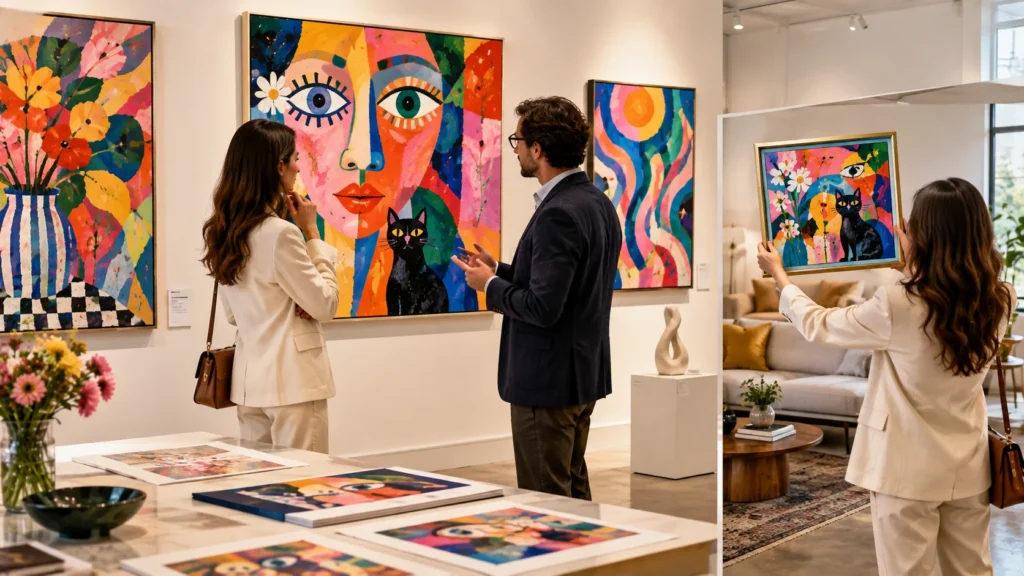
Independent artist marketplaces — platforms where individual artists sell original work or limited prints directly — tend to offer the widest and most genuinely varied selection of funky art, since the style thrives on individual artistic voice rather than mass production. Local art fairs and independent gallery shows are also strong sources, particularly for original, one-of-a-kind pieces rather than reproductions.
For more accessible, budget-friendly options, home decor retailers increasingly carry funky-style prints and reproductions, though the selection tends to lean toward safer, more “decor-friendly” interpretations of the style compared to what you’d find through independent artists. If originality and uniqueness matter to you, prioritize sources that clearly identify the individual artist and specify whether a piece is an original or a reproduction, since that distinction significantly affects both price and long-term value.
How to Style Funky Art in Any Space
Funky art tends to work best as a focal point rather than one of several competing bold elements in a room. Pairing a bold, funky piece with simpler, more neutral furniture and decor lets the art carry the visual energy without the space feeling overwhelming. A practical approach: pull one or two colors directly from the piece and echo them in smaller decor details elsewhere in the room — this visually ties the art to the space rather than leaving it feeling like an isolated addition.
Scale matters too. A small funky piece in a large, minimal room can look disconnected, while a well-sized piece — filling a meaningful portion of the available wall space — reads as an intentional statement rather than an afterthought.
Common Mistakes to Avoid
Assuming all colorful art is “funky.” Bold color alone doesn’t guarantee the style; the looser, more expressive, often humorous quality is what actually defines it, not saturation alone.
Overcrowding the piece with competing bold decor. Funky art generally works best with a calmer surrounding backdrop, since it gives the piece room to be the clear focal point.
Buying without confirming original vs. reproduction. This distinction significantly affects price and value, and it’s easy to overlook when a piece is visually striking enough to distract from that detail.
Expert Tips
- If you’re new to the style, start with a smaller, more affordable funky piece before committing to a large statement work, to see how the energy fits your space and taste.
- Look specifically for independent artist marketplaces if uniqueness matters to you, since mass-market retailers tend to offer safer, more homogenized interpretations of the style.
- Photograph a potential piece styled in your actual space before buying, since bold colors can read very differently in a product photo than in your room’s actual lighting.
Frequently Asked Questions
Not exactly — they overlap significantly, but pop art specifically references bold, graphic, often culturally referential imagery, while funky art is a broader, looser style descriptor that can include pop art influences alongside psychedelic, abstract, or mixed-media approaches.
Independent artist marketplaces, local art fairs, and independent gallery shows tend to offer the widest selection of original funky pieces, generally with more variety than mass-market home decor retailers.
Yes — in fact, a calmer, more neutral backdrop often makes funky art more effective, since it gives the bold piece room to stand out as a clear focal point rather than competing with other busy elements.
Look for playful or unexpected shapes, unconventional color combinations, and a sense of energy or humor in the composition — bold color alone, without that looser, expressive quality, doesn’t necessarily qualify as funky.
It varies widely depending on whether you’re buying an original piece from an independent artist or a mass-produced reproduction; originals from established artists generally cost more, while reproductions from decor retailers tend to be more budget-friendly.
Final Takeaway
Funky art is defined less by a strict formula and more by a feeling — bold, expressive, a little irreverent, and genuinely full of personality. Whether you’re buying an original piece from an independent artist or a more accessible reproduction, the same principle applies: let it be the room’s clear focal point, and keep the surrounding space simple enough to let that energy do its work.

At Decor Artly, we bring art, home decor, and personal style together to create beautiful spaces and inspiring lifestyles. Led by Design Director Roni, we offer curated artwork, elegant home accents, and personalized styling to help you express your unique taste.